
While traditional paper-and-pencil tests must necessarily be administered on site and under supervision (controlled mode), many digital tests also allow sending a test link so that the test person can complete the test location-independent unsupervised (open mode) or supervised online (proctored mode). In other words, different testing modes are available. The testing mode in which a test can be administered depends not only on the technology on which it is based, but also on other factors such as the current legal situation regarding assessments, the test design, or the consent of the test authors to use the test for certain testing modes.
The Marketplace shows which testing modes are supported for each test:

In the VTS, you can filter your licensed tests by the available modes on the Testing page:
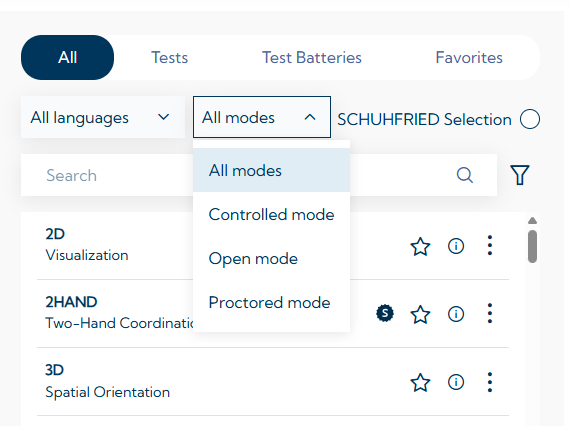
Testing modes
As mentioned above, there are three different testing modes in the VTS: controlled mode, proctored mode and open mode. The order of the testing modes listed below also represents a hierarchy, arranged by test security and the degree of controlled administration conditions. All tests are available in controlled mode, i.e., the highest level of test security and control. Some of these tests can also be administered in proctored mode or even in proctored and open mode.
Controlled mode
Controlled mode refers to the administration of a test on site and under the supervision of a trained test administrator. This allows any questions or uncertainties on the part of the test person to be clarified quickly. This mode also offers the highest level of test security, as cheating can usually be ruled out. Tests that require peripheral devices such as a SCHUHFRIED Panel are only available in controlled mode.
In order to present a test in controlled mode you have to start a test on a PC manually (see VTS - First Steps) or via Direct Testing by Group testing on-site.
Proctored mode
Proctored mode refers to the location-independent supervised administration of a test via a test link. This link is generated via the VTS and sent to the test administrator (proctor). Only once the online supervision is established, e.g., via a video conferencing tool, is the link handed over to the test person. Proctored mode combines the advantages of open and controlled mode (location-independent but supervised testing), but requires increased administrative effort, as appointments must be coordinated and technical infrastructure and a test administrator must be available for supervision. As with controlled mode, several people can be supervised simultaneously via proctoring if the technical facilities are available. This means that group testing (up to a certain number of people) is also possible in proctored mode.
Open mode
Open mode refers to the location-independent unsupervised administration of a test via a test link generated by the VTS and usually sent by email. Test persons are therefore free to decide how and when they want to take the test. For test administrators, this means minimal administrative effort and maximum reach, but test security is lower and the conditions for taking a test can be recommended but not controlled.
Different modes for different test forms
Some tests differ in their available test modes depending on their test form. For example, the INT cannot be started in open mode in the standard test form S1, but only in proctored mode or controlled mode. However, for the adaptive test form S2 of the INT open mode is available. The filter function can be used to search for the available test forms. However, please note that the setting in this filter also affects the test sequence and which options for starting a test are available.
