
This example illustrates how VTS Analytics can support cognitive rehabilitation and longitudinal monitoring of patients.
You are a neuropsychologist working in a vocational rehabilitation center that focuses on cognitive rehabilitation following stroke, traumatic brain injury, or substance use disorder. To assess the neurocognitive level of functioning, you use the SFS Test Solutions Substance Use Disorders - Neurocognitive Assessment and Brief Neurocognitive Assessment as a basic screening of neurocognitive domains. Depending on the patient’s anamnesis, you may add additional tests to further assess specific cognitive functions.
The individual cognitive profile of a patient can already be reviewed in the test result report. However, you decide to use VTS Analytics to compare the patient’s results not only with the normative reference population but also with the average performance of patients with the same diagnosis in your clinic.
To enable this comparison, you enter the diagnosis code as a Scoring Code during data collection.
Comparing the Patient with the Clinical Sample
After testing, you open Results - Comparison with average in VTS Analytics. In the Settings panel, you select the individual patient whose results you want to analyze.
Next, you restrict the comparison sample by applying filters. Under Filters, you limit the dataset to:
-
patients from your clinic
-
the relevant demographic group
-
the corresponding diagnosis group
You then activate Show confidence intervals in the Settings panel and select T-scores as the norm-referenced score metric. T-scores are normally distributed with a mean of 50 and a standard deviation of 10, which allows for appropriate statistical comparison between an individual and a sample average.
The results are shared with the physicians and psychologists involved in the patient’s therapy. This allows them to see how the patient performs not only relative to the norm population, but also relative to the clinical population typically treated in the center. such comparisons provide therapists with clinically relevant reference points for their everyday clinical work.
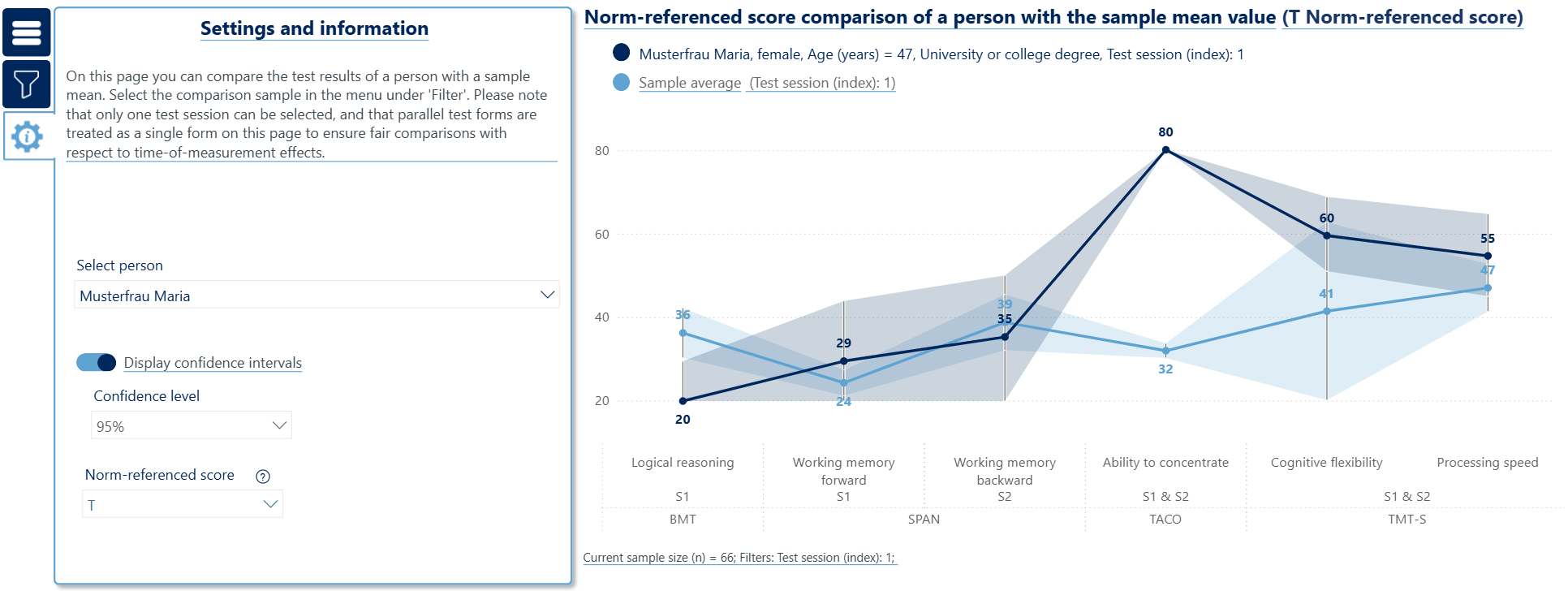
The analysis shows that the patient performs two standard deviations below the norm population mean in short-term memory (SPAN S1). However, compared with the clinic’s typical patient population, the patient performs slightly above the average level. The difference is not statistically significant when taking into account the sample size and test reliability.
In logical reasoning, the patient performs three standard deviations below the norm population mean, which is also below the clinic’s average performance for patients with the same diagnosis. In this case, the difference is statistically significant, as the confidence intervals do not overlap.
At the same time, the patient shows clear cognitive strengths. Their ability to concentrate and processing speed are above average, and cognitive flexibility appears largely unaffected. These findings provide valuable information for tailoring an individualized cognitive rehabilitation plan.
Monitoring Cognitive Progress Over Time
After some time in therapy, the patient is tested again to monitor possible improvements.
To evaluate changes in performance, you open Results - Comparison over time in VTS Analytics and again select the patient in question. At this stage, the patient has completed follow-up testing for working memory and processing speed.
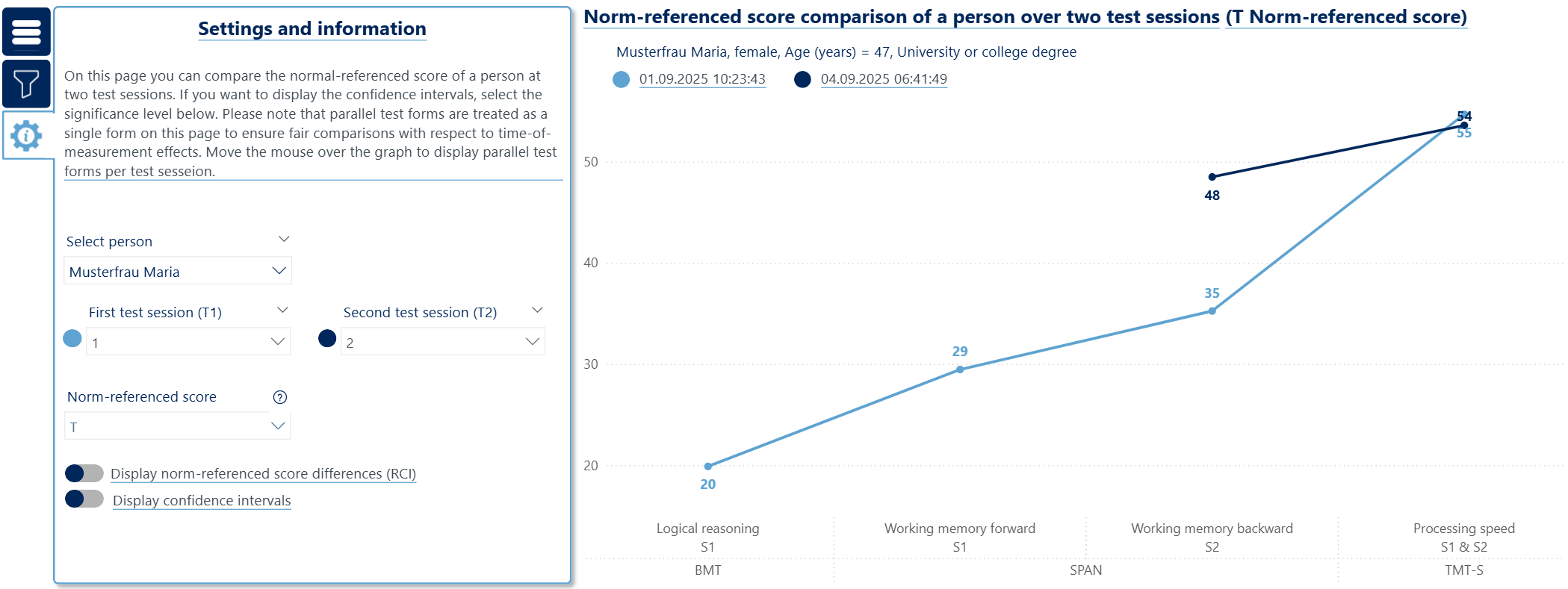
To determine whether the observed changes are statistically meaningful, you activate Display norm-referenced score differences (RCI). This option calculates the Reliable Change Index (RCI), which takes the reliability of the test into account.
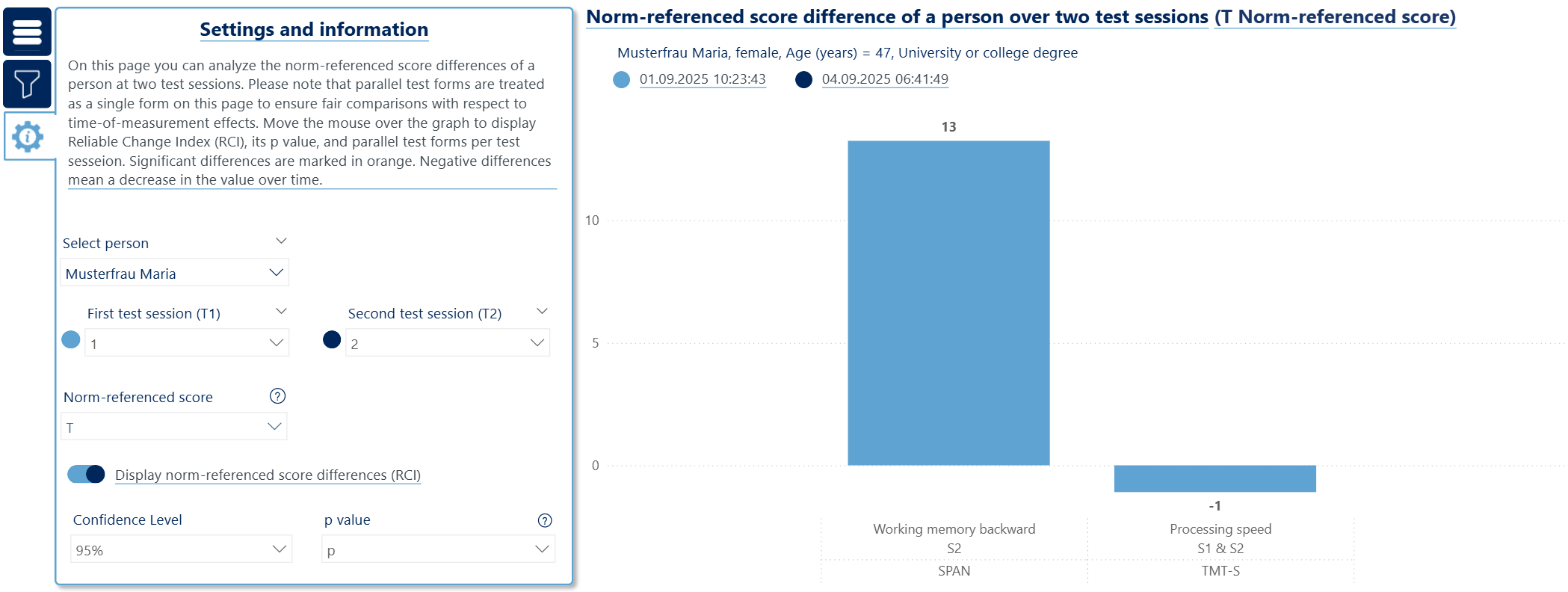
At a significance level of 95% with one-sided testing (testing specifically for improvement), the observed improvement of 13 T-score points does not yet reach statistical significance.
By hovering over the graph, you can directly inspect the values for:
-
norm-referenced score at time 1 (admission)
-
norm-referenced score at time 2 (monitoring)
-
the difference between the scores
-
the Reliable Change Index
At the time of discharge, the patient completes the full cognitive test battery again.
Using Results - Comparison over time, you compare the results from time 1 (admission) with time 3 (release). This allows you to quickly obtain the reliable change indices, score differences, and norm-referenced values across all cognitive variables.
These results provide an objective basis for evaluating the patient’s cognitive recovery during rehabilitation and can be included in the final clinical documentation.