
“How does test performance compare across individuals?”
On this page you can compare test results of up to four persons. Upon displaying confidence intervals, you can investigate if confidence intervals of two persons overlap with each other or with the average range.
You have to select one person in the “Settings” panel in order for data to be displayed.
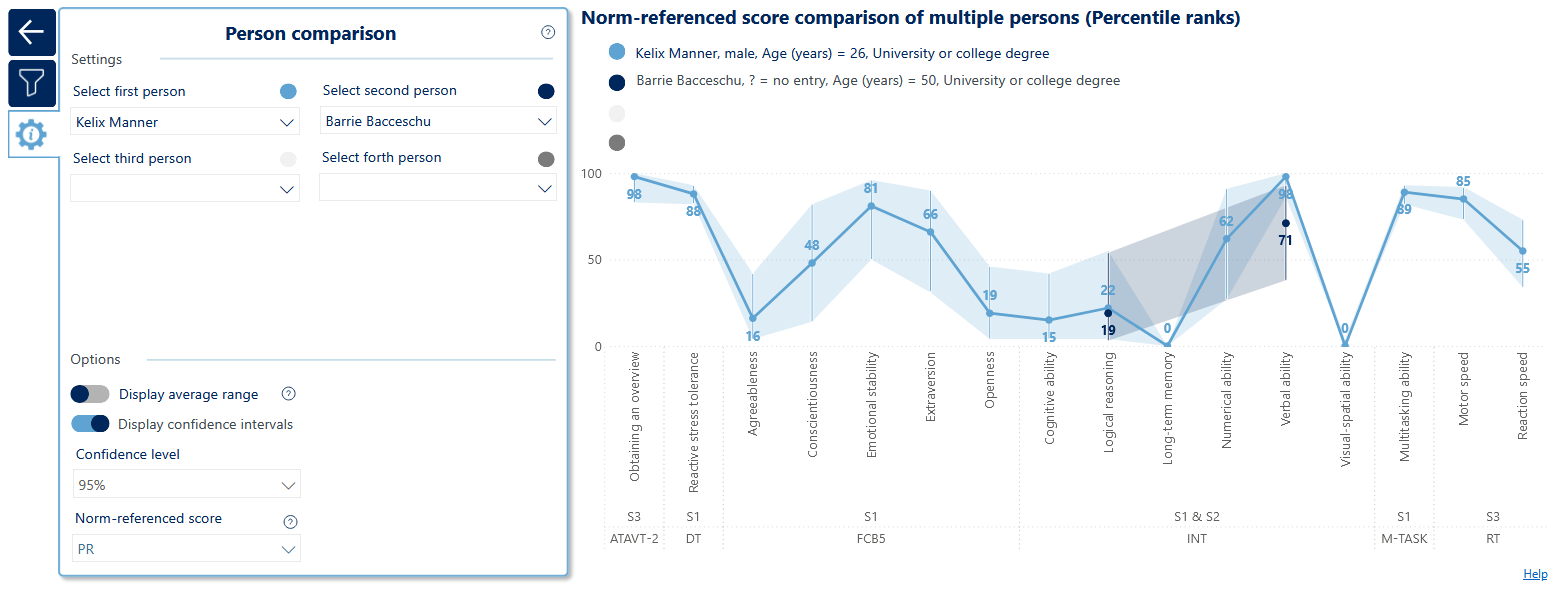
Please note that only one test session can be selected, and that parallel test forms are treated as a single form on this page to ensure fair comparisons with respect to time-of-measurement effects. This means, for example, that:
-
The first administration of Person A can be compared with the first administration of Person B.
-
The second administration of Person A on the TMT-S, test form S1 or test form S2 can be compared with the second administration of Person B on the TMT-S, test form S1 or test form S2 (parallel forms)
-
However, the first administration of Person A cannot be compared with the second administration of Person B.
Norm-referenced score confidence interval scaling
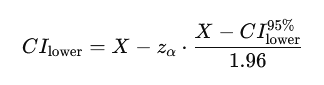
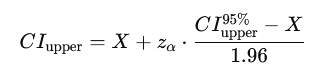
The resulting lower and upper bounds of the norm-referenced score confidence interval are then scaled based on zα value chosen:
Using the formulas
where
-
X is the observed score at the respective test session in the selected score scale
-


-
1.96 is the critical value for a 95% confidence interval
-
zα is the critical value corresponding to the confidence level selected in VTS Analytics
This means that the width of the exported 95% confidence interval is proportionally adjusted to match the selected confidence level. Because percentile ranks are not a linear transformation of the z scale, confidence interval scaling is first performed on the underlying z metric. The rescaled confidence bounds are then transformed back into percentile ranks using the cumulative distribution function (ECDF/CDF) of the standard normal distribution.